TL;DR
- The Adonis Index is a shoulder-to-waist ratio commonly associated with the golden ratio, approximately 1.618.
- It is not a medical standard or universal law. It is a visual proportion framework.
- Waist circumference is often the most controllable variable and can produce the fastest visual return.
- Lateral delts, lats, upper chest, and controlled body composition drive the strongest changes in the ratio.
- The best strategy depends on the bottleneck: waist, shoulders, back width, upper chest, arms, or overall balance.
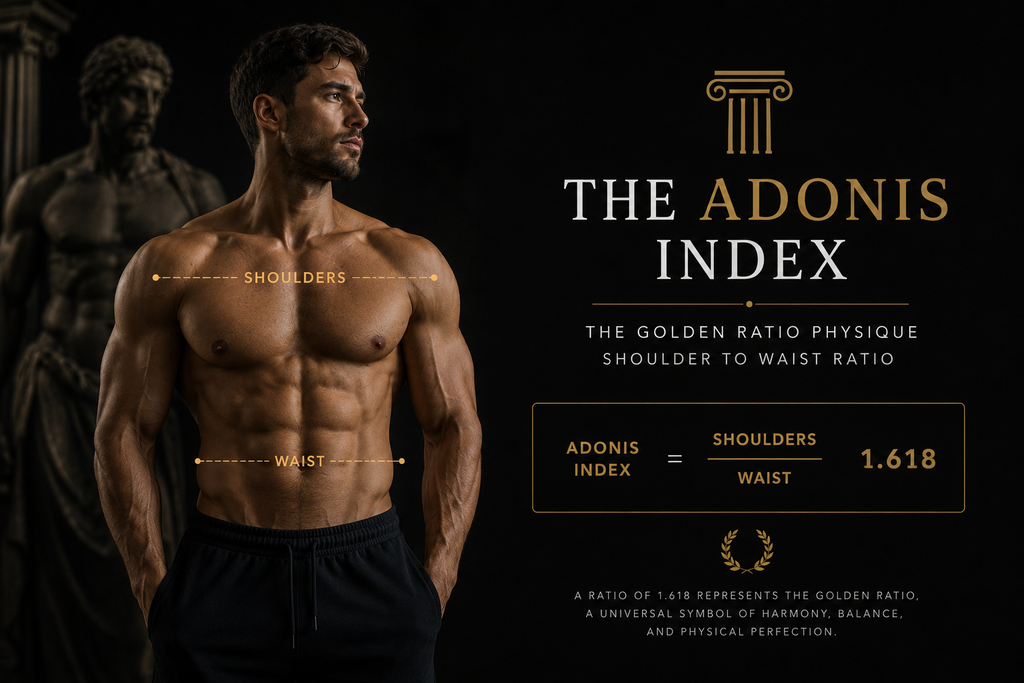
The Adonis Index is commonly described as a shoulder-to-waist ratio aligned with the mathematical golden ratio, approximately 1.618. In physique terms, it is used to evaluate how much shoulder width exists relative to waist circumference.
It is not magic. It is not a medical standard. It does not define health, masculinity, or physical value. Used properly, it is a useful visual proportion framework that helps identify whether a physique would benefit more from waist reduction, shoulder development, lat development, or overall body composition work.
The reason it matters is simple: proportion often changes visual impact more than raw size. A man with moderate muscle and a controlled waist can look more athletic than someone heavier with less structural contrast.
To calculate your current ratio and identify your highest-return improvement path, use the Body Proportion Calculator.
Core Formula
Shoulders divided by waist.
The calculator uses the same equation, compares the result against the 1.618 reference target, and identifies whether waist, shoulders, back width, or balanced recomposition is the stronger priority.
52 inch shoulders / 32 inch waist = 1.625
What Is the Adonis Index?
The Adonis Index is calculated with a direct formula:
Shoulder circumference / waist circumference = Adonis Index
The commonly discussed target is approximately 1.618. For example, 52 inch shoulders divided by a 32 inch waist creates a ratio of 1.625.
That result is close to the golden-ratio reference. The mathematical golden ratio has been discussed in art, architecture, design, and visual proportion for centuries. In male physique conversations, it became popular because it reflects the broad-shouldered, narrow-waisted look associated with a strong V-taper.
That does not mean every physique should chase the same number. It means the ratio can help organize training priorities with more precision.
Does Height Matter?
The ratio itself is based on proportion, not height. A 5'8" man and a 6'3" man can technically have the same Adonis Index if their shoulder and waist measurements scale accordingly.
Height still matters visually because taller men usually need more absolute muscle to create the same level of density and width. A shoulder measurement that looks powerful on one frame may look underdeveloped on a longer frame.
Bone structure also changes the starting point. Important structural variables include clavicle width, rib cage depth, pelvic width, wrist size, and ankle size.
The practical rule is this: waist is the most controllable variable, bone structure determines natural frame advantage, and height determines how much muscle is needed to fill the frame.
Is the Adonis Index Only for Men?
The Adonis Index was developed around male shoulder-to-waist aesthetics. It is most useful when evaluating the V-taper, shoulder width, and waist control that typically define male physique proportions.
Women can still evaluate shoulder-to-waist proportion, especially for posture and upper-body balance, but female body proportion analysis is usually better assessed with waist-to-hip ratio, hip-to-waist ratio, glute development, shoulder balance, and overall structural balance.
For the female-focused framework, read Female Body Proportions: Waist-to-Hip Ratio, Structural Balance, and How to Improve Your Shape.
Why Some Men Look More Muscular at the Same Weight
Two men can weigh the same and look completely different. The difference is rarely explained by scale weight alone.
The main variables are muscle distribution, shoulder width, lat development, upper chest development, waist circumference, body fat distribution, posture, and abdominal control.
A man who carries more muscle through the delts, lats, and upper torso will usually look broader and more athletic than someone with the same weight distributed less strategically. A smaller waist amplifies this effect because every inch removed from the waist increases the visual contrast of the upper body.
Body fat distribution matters as well. Visceral fat tends to push the abdomen outward from deeper within the trunk. Subcutaneous fat sits beneath the skin. Both can affect waist measurement, but visceral fat often changes the torso silhouette more aggressively.
Posture also changes presentation. Rounded shoulders, poor rib positioning, weak abdominal control, and excessive anterior pelvic tilt can make the waist appear larger and the upper body less structured.
Measure the bottleneck, not just body weight
If waist size or body composition is limiting your ratio, scale weight alone will not show the full picture. Use the Body Composition Estimator alongside the proportion calculator.
The Physiology Behind the Adonis Index
The shoulder-to-waist ratio functions as a visual signal of upper-body strength, low to moderate body fat, and frame dominance. It is not a complete health marker, but it does reflect several trainable qualities.
Lateral delts increase apparent width. Rear delts support the shoulder cap and help prevent the collapsed posture that hides upper-body structure. Lats create the V-taper from both the front and the back. Upper chest adds torso density and supports the clavicle line.
Waist size either reduces or amplifies the entire effect. A wider waist can make developed shoulders look less impressive. A controlled waist can make moderate shoulders look sharper.
Core training does not directly burn belly fat. Dead bugs, planks, side planks, Pallof presses, farmer carries, and controlled breathing work can improve trunk stiffness, posture, and abdominal control. They do not spot-reduce fat. Nutrition and energy balance drive fat loss.
01
Waist Control
Usually the fastest visual return when body fat or trunk presentation is the limiter.
02
Shoulder Width
Lateral and rear delts increase apparent width and improve the ratio directly.
03
V-Taper Width
Lats create the visual taper from the front and back, even when circumference changes slowly.
How to Improve Your Adonis Score
The strongest plan is not the most complicated plan. It is the plan that addresses the current bottleneck. Your calculator result should tell you where the highest-return improvement path sits.
If Your Waist Is the Primary Limiting Factor
Reducing waist circumference usually produces the fastest visual improvement. A smaller waist improves the ratio immediately and makes every inch of shoulder, lat, and chest development look more pronounced.
A high waist measurement can come from excess body fat, visceral fat, bloating, posture, poor trunk control, breathing mechanics, alcohol intake, sleep disruption, stress, or a combination of several factors.
The solution is not crash dieting. Use a controlled calorie deficit, enough protein, daily movement, resistance training 3-4 times per week, and conditioning that matches recovery.
HIIT can help with energy expenditure and conditioning. Zone 2 cardio can provide lower-stress aerobic work 2-3 times per week. Core training improves control, posture, and trunk stiffness. Nutrition drives fat loss.
Set protein before you cut harder
Waist reduction should not come at the cost of lean mass. Use the Protein Calculator to set a practical intake target before pushing the deficit more aggressively.
If Shoulders Are the Primary Limiting Factor
Lateral deltoids create the greatest direct visual impact on shoulder-to-waist ratio. Rear delts improve shoulder cap, posture, and upper-body balance. Pressing alone is usually not enough.
The best tools are controlled, targeted, and repeatable: cable lateral raises, machine lateral raises, lean-away lateral raises, rear delt cable flyes, face pulls, and controlled overhead pressing if shoulders tolerate it.
Most men should use 10-20 hard weekly sets for delts across 2-4 sessions. The priority is controlled tempo, progressive overload, and clean execution. Trap-dominant lateral raises and ego lifting usually reduce the quality of the stimulus.
If Lats and Back Width Are the Primary Limiting Factor
Lats create the V-taper from behind and from the front. Back width can visually improve the ratio even when shoulder circumference changes slowly.
Prioritize pull-ups or assisted pull-ups, neutral-grip pulldowns, one-arm cable pulldowns, chest-supported rows, and straight-arm pulldowns.
Use a vertical pulling emphasis, full stretch, and controlled scapular movement. Avoid turning every pull into a biceps exercise. The target is width, not just moving weight.
If Upper Chest or Arms Are Lagging
Upper chest supports the clavicle line and creates a more athletic torso. It complements shoulders and lats by adding density where many physiques look flat.
Arms matter, but they are usually secondary to shoulders, lats, and waist. Bigger arms do not fix a weak V-taper by themselves.
A strong refinement plan can include incline dumbbell press, low-incline pressing, incline cable flyes, landmine presses, overhead cable extensions, rope pressdowns, incline curls, preacher curls, and hammer curls.
If Legs Are Lagging
Legs do not directly increase the Adonis ratio, but they affect overall physique balance. A top-heavy look is not the same as a complete physique.
Squats or leg press, Romanian deadlifts, split squats, leg curls, and calf raises help keep the physique balanced while improving strength and athletic structure.
Sample Improvement Scenarios
Example 1
Shoulders 49", Waist 35"
The ratio is 1.40. The priority is waist reduction because every inch lost at the waist improves the visual contrast immediately.
Example 2
Shoulders 52", Waist 32"
The ratio is 1.625. This is already near the reference range. The priority is maintaining waist control while refining upper chest, lats, and arms.
Example 3
Shoulders 47", Waist 31"
The ratio is 1.52. The waist is controlled, so delt and lat development usually have the higher return than more aggressive fat loss.
What the Adonis Index Cannot Tell You
The Adonis Index cannot measure health by itself. It does not replace body composition testing. It does not account perfectly for height, frame, age, injury history, or training age.
It is a visual proportion tool, not a medical diagnosis.
Use the Ratio Without Chasing Perfection
- Adonis Index = shoulder circumference divided by waist circumference.
- The common reference target is approximately 1.618.
- Height does not change the ratio, but it changes how much muscle is needed to create the same visual effect.
- Bone structure influences the starting point. Training and body composition determine how much can be improved.
- Waist reduction, lateral delt growth, lat width, and upper chest development are the main levers.
Research supports the general visual effect of broader shoulders and a comparatively narrower waist or hips. It does not establish 1.618 as a universal biological ideal, so the Adonis Index is better used as a planning reference than a scientific law.[1][3]
Proportion also does not operate in isolation. Height, body fat, and the rest of the frame change how the same ratio looks, and recent research suggests body-fat level may influence attractiveness ratings more consistently than shoulder-to-waist ratio alone.[2][4]
Research and References
These studies support broad V-taper principles while showing why one ratio cannot define an ideal physique.
- Pazhoohi et al. “Neural Correlates and Perceived Attractiveness of Male and Female Shoulder-to-Hip Ratio.” Larger shoulder-to-hip ratios affected attractiveness ratings and neural responses in this controlled study. View on PubMed.
- Yang et al. “The Interacting Effects of Height and Shoulder-to-Hip Ratio.” This study found that height and upper-body proportion interact in judgments of attractiveness and masculinity. View on PubMed.
- Swami and Tovée. “Male physical attractiveness in Britain and Malaysia.” The study examined waist-to-chest ratio, BMI, and cultural context rather than validating one universal golden ratio. Read via DOI.
- Wang et al. “The relationship between body fatness and physical attractiveness in males.” This cross-cultural study compared body-fat percentage, BMI, and shoulder-to-waist ratio. Read via DOI.
FAQ
What is the Adonis Index?
The Adonis Index is a shoulder-to-waist ratio used as a visual physique proportion reference. It is calculated by dividing shoulder circumference by waist circumference.
What is a good Adonis Index score?
Below 1.40 suggests a major improvement opportunity, 1.40-1.49 is developing, 1.50-1.59 is strong, and 1.60-1.65 is near the golden-ratio reference.
Does height affect the Adonis Index?
Height does not change the formula, but taller frames usually need more absolute muscle to create the same visual impact.
Can you improve your Adonis Index?
Yes. You can improve it by reducing waist circumference, building lateral delts, developing lats, improving upper chest, and controlling body composition.
Do ab exercises improve the Adonis Index?
Ab exercises can improve trunk control and posture, but they do not spot-reduce belly fat. Waist reduction depends mostly on body composition and energy balance.
What muscles improve shoulder-to-waist ratio most?
Lateral delts, rear delts, lats, and upper chest usually have the strongest visual effect on shoulder-to-waist proportion.
Is the Adonis Index only for men?
It is most useful for male shoulder-to-waist aesthetics. Women can evaluate shoulder balance, but waist-to-hip ratio and structural balance are usually more useful.
Is the Adonis Index a health measurement?
No. It is a visual proportion tool, not a medical or health diagnostic measurement.